
Corporate Tax Filing Deadline UAE 2026: Key Dates & Penalties
If the financial year for your organisation ends on 31 December 2025, FTA will need you to submit your tax returns and payment in full before 30 September 2026, nine months from the end of the financial year, with no provision for extension of filing deadlines. Failure to adhere to this deadline attracts automatic penalties regardless of whether there is any tax due. In our experience at Pearl Accounting, understanding the UAE corporate tax filing deadline early helps businesses plan their records, calculations and filing requirements without last-minute pressure.
Pearl Accounting & Financial Services LLC has been offering bookkeeping services in Dubai for more than 15 years and caters to small businesses, startups, and foreign investors in the UAE.

When Is the UAE Corporate Tax Filing Deadline?
According to Federal Decree-Law No. 47 of 2022 on the Taxation of Corporations and Businesses, it is the obligation of all taxable persons in the UAE to file returns and make payment of taxes due within nine months of their fiscal year-end. The nine months is known as the corporate tax filing deadline.
This is because the filing deadlines are based on the company's individual fiscal year-end, and not a specific day. As a result, many business owners choose to work with professional accounting services in Dubai to keep their financial records organised and stay on top of important deadlines. In the case of businesses adopting the calendar year, the return for year-end 2025 will be filed by 30 September 2026.
What Is the Nine Month Rule?
The nine-month rule lies at the core of the regime for corporate tax in the UAE. While many tax systems fix the date of submission of accounts and tax returns for all taxable individuals at one time, in the UAE corporate tax regime, every taxable individual gets nine months after the end of their financial year to do so via EmaraTax.
At Pearl, we typically recommend that businesses do not leave the final two weeks of the compliance period for filing and payment. The tax is payable precisely on the same date as the tax return. There is no separate period when you can pay your tax. In our experience, allowing sufficient time for final calculations, account reconciliation and document checks can help businesses avoid unnecessary last-minute pressure.
When Are the Important Filing Dates for 2026?
Your filing date depends on the close of your financial year, so at Pearl, we recommend confirming the applicable deadline well in advance. Some important filing dates are:
Financial Year End | Corporate Tax Filing Deadline |
31 December 2025 | 30 September 2026 |
31 January 2026 | 31 October 2026 |
31 March 2026 | 31 December 2026 |
30 June 2026 | 31 March 2027 |
The vast majority of companies in the UAE operate on a financial year from January to December, making the UAE corporate tax filing deadline for 2026 fall on 30 September 2026.
Corporate Tax Filing Preparation Checklist
Before your filing deadline, make sure you have:
✓ Updated bookkeeping records
✓ Reconciled bank and financial accounts
✓ Accurate financial statements
✓ Related-party transaction details
✓ Supporting documents for applicable reliefs
✓ Corporate Tax registration details
✓ Reviewed taxable income and adjustments
✓ Completed final tax calculations
✓ Checked the return before submission
At Pearl, we find that completing these checks before the final filing month gives businesses more time to identify and resolve discrepancies.
Who Is Required to Pay Corporate Tax in the UAE?
One of the common areas we clarify with clients is that Corporate Tax compliance is not limited to businesses that have made a profit. Businesses may still have a filing obligation even where no Corporate Tax is ultimately payable. The following organisations are required to file corporate tax returns:
Mainland corporations, irrespective of their size and profitability.
Free zone organisations and Qualifying Free Zone Persons that are taxed at 0% on their qualifying income.
An organisation which makes zero profit or is claiming relief under the small business relief scheme.
Non-residents of the UAE making a taxable presence in the UAE.
Even if there is no requirement to pay tax, filing the tax return may still be obligatory. Businesses can use Corporate Tax services in Dubai to review their registration and filing requirements before the deadline.
Penalties for Missing the Tax Return Filing Deadlines
Failure to meet the corporate tax filing deadline results in automatic penalties, which are set out in Cabinet Decision No. 75 of 2023, regardless of whether or not there is any actual tax that needs to be paid. Current penalties for failing to file include the following:
AED 500 per month, or portion thereof, for up to twelve months.
AED 1,000 per month starting from the thirteenth month.
14% annual interest for any tax owed, computed monthly from the date immediately following the deadline.
AED 10,000 penalty for failure to register for corporate tax, but this can be waived if the first tax return is submitted within seven months from the end of the first tax period.
In our experience, penalties can accumulate quickly when compliance is delayed. For example, a 13-month delay in submitting the tax return can result in more than AED 6,500 in late-filing penalties alone, excluding interest on unpaid taxes.
Documents Required Prior To Filing
Prior to filing, some of the documents that a business will require include organised financial statements, the list of related party transactions, documentation supporting Free Zone and/or Small Business relief claims, and information on adjustments made based on the Corporate Tax Law.
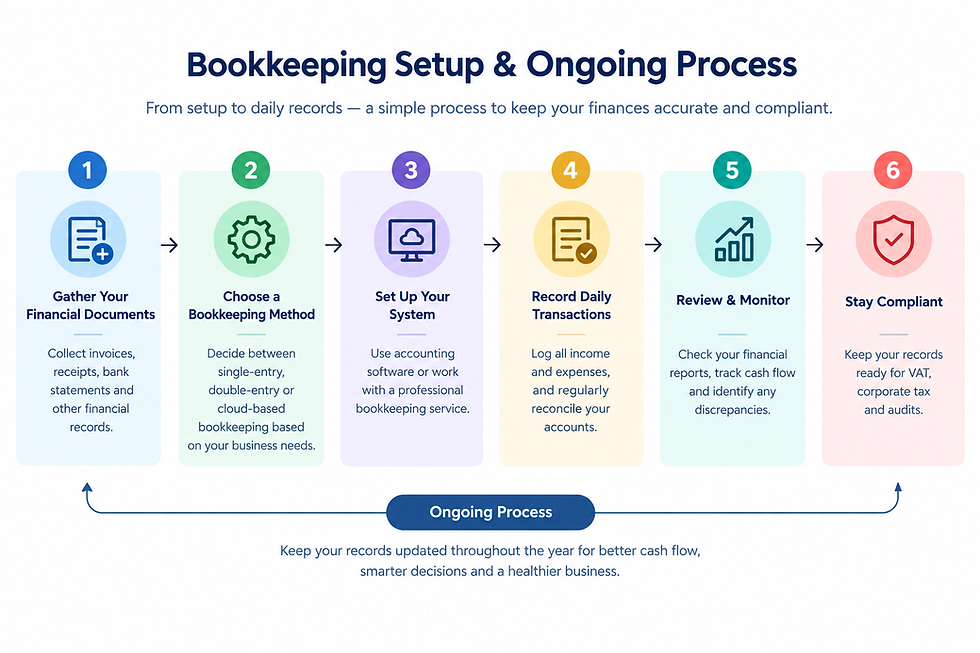
Most businesses benefit from using bookkeeping services in the UAE to ensure that these documents remain accurate and up to date rather than having to organise everything immediately before filing.
At Pearl, we pay particular attention to financial and management reporting accuracy because the amounts reflected on the tax return should tie in with the underlying accounting records and relevant financial statements. Differences between financial records and tax calculations are one of the issues we look for during our Corporate Tax reviews.
How Should Businesses Get Ready Before 2026 Arrives?
At Pearl, we typically recommend starting Corporate Tax preparation well before September arrives. Getting accounts reconciled beforehand, ensuring that elections for Free Zone or tax relief are properly recorded, and assessing whether a company is registered for Corporate Tax can minimise the chances of making mistakes at the last minute.
Businesses that need help reviewing their financial position can also use accounting services in Dubai for ongoing financial record management and compliance support.
When the calculations are complicated, especially if there are related-party dealings and issues relating to transfer pricing, it is best to check the tax return with professional Corporate Tax services to reduce the risk of errors.
What Are the Common Problems in Filing Documents by Businesses?
One of the most common issues we see at Pearl is that accounting documentation is incomplete or not organised well enough, making it harder to accurately calculate taxable income. A lot of companies also underestimate the amount of time required to collect supporting documentation for transactions between related parties or for applicable elections, leaving little room for corrections.
In addition, some firms improperly apply rules regarding Free Zones or do not claim applicable deductions. During our Corporate Tax reviews, these issues can become visible only after we examine the company's wider financial picture. This is why regular bookkeeping and accounting reviews can be more useful than waiting until the annual filing deadline.
For businesses that need ongoing record management, Pearl's bookkeeping services can help keep financial information organised throughout the year.
What Is Your Next Step When You Fail to File in Time?
We sometimes see businesses reach September and realise that their books are not yet ready for filing, despite having started the process earlier. It is important to understand that ignoring the deadline can lead to further compliance issues.
If you suspect that the deadline cannot be met, it is necessary to contact an appropriate tax professional, understand the applicable penalties, collect the available supporting documents, and submit the most accurate return possible rather than unnecessarily delaying the process.
Where corrections are required after submission, businesses should assess the appropriate correction process based on the nature of the error and applicable FTA requirements.
Transforming Your Compliance Into a Simple Task
From our experience at Pearl, managing Corporate Tax compliance throughout the year makes the filing process much easier to manage. Understanding your deadline, maintaining good records throughout the year, and reviewing your tax position regularly can help businesses stay prepared rather than being forced into action just before September.
Pearl Accounting & Financial Services LLC has helped more than 150 companies in the UAE with accurate bookkeeping, VAT and Corporate Tax preparation, with over 15 years of professional experience in the field.
Whether you require help verifying your registration, assistance with your tax return, or an objective review of your financial information, Pearl provides professional support based on your business requirements.
If your business also needs support with VAT compliance alongside Corporate Tax, you can explore Pearl's VAT Services in UAE. For businesses preparing for digital invoicing requirements, Pearl also provides E-Invoicing Services in UAE.
Schedule a complimentary consultation with Pearl Accounting & Financial Services LLC and prepare your Corporate Tax return ahead of the deadline.
FAQs
But what happens if I register my company for Corporate Tax late but the first tax return is filed on time?
Under Cabinet Decision Number 10 of 2024, it is possible to waive the late filing fee of AED 10,000, so long as the filing of the first tax return is made within seven months from the end of the first tax period.
Should I still file even though my Free Zone company is eligible for the 0% tax rate?
Yes. If you fall into the category of Qualifying Free Zone Persons who are subject to 0% on qualifying income, then you are required to file a return. This is because filing will help the FTA determine whether your company meets the applicable requirements for such preferential tax treatment.
Can I make corrections to a previously submitted Corporate Tax return?
Yes, you can do so through the applicable correction or voluntary disclosure process in EmaraTax, depending on the circumstances. In our experience, addressing an identified error promptly is preferable to waiting until the issue becomes more difficult to resolve.
Are there differences between the payment deadline and the deadline for filing?
There are no differences. The UAE does not have provisions for provisional or advance instalments. Hence, both the filing and tax payment deadlines occur simultaneously when the return is submitted.
Which records does a company need to maintain for the Corporate Tax return?
The business should keep financial statements, invoices, and details of related-party transactions along with calculations supporting the Corporate Tax return for the required retention period. Proper maintenance of these records throughout the year makes the filing process easier.
Need help preparing for your Corporate Tax deadline? Pearl Accounting & Financial Services LLC provides accounting, bookkeeping, VAT, Corporate Tax and E-Invoicing support for businesses across the UAE.

Comments