
FTA Decision No. 17 of 2026: What UAE Businesses Need to Know About Recovering Input VAT on Employee Expenses
Businesses are allowed to get VAT refunds for staff welfare, but only in six distinct categories and only if all the conditions in that particular category have been fulfilled. These rules came into effect on 1 October 2026 and include transportation, food, lodging, new joiners' accommodation, telecommunications, and parking facilities. As a result, input VAT on employee expenses in the UAE now needs a written contract or policy behind every claim.
This Decision directly affects how much input VAT on employee expenses in the UAE a business can legally recover each tax period. Claiming outside the six categories, or without matching documentation, risks a disallowed claim and can trigger a review of earlier VAT returns. Checking your benefits structure now, as part of your wider accounting services in Dubai, is far simpler than correcting it after a filing.
Pearl Accounting & Financial Services LLC has over 15 years of experience helping more than 150 UAE businesses with VAT, bookkeeping and compliance. Our team can help you apply these rules to your own payroll and benefits, in English or French.
Not sure whether your current benefits structure would survive an FTA review? Speak with a Pearl advisor and we will check it against the six categories before you file.
What Does the New Decision Actually Say?
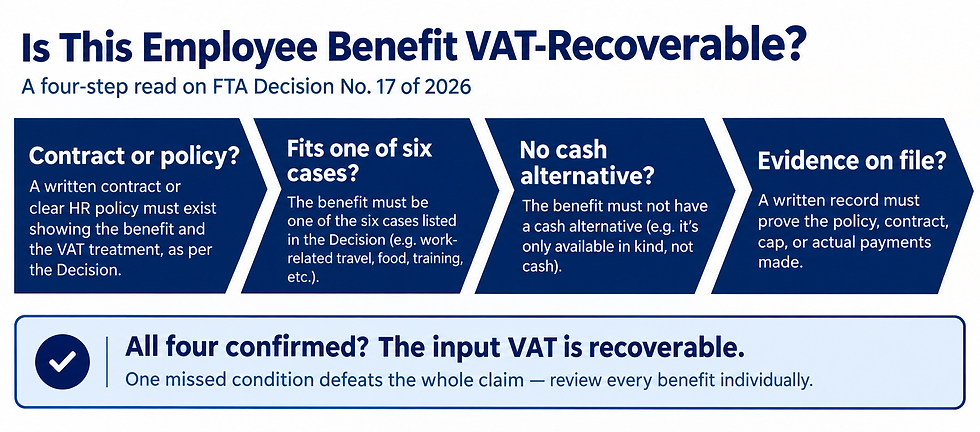
FTA Decision No. 17 of 2026 was issued on 9 September 2026 under Article 53(1)(c)(2) of the VAT Executive Regulation, and it sets out when an employer can recover input tax on goods and services provided to employees free of charge. It applies only where a contract or documented policy obliges the employer to provide them, so an informal perk falls outside it.
The Decision follows Cabinet Decision No. 149 of 2026, which removed the old "normal business practice" wording and left the Authority to define the qualifying cases. In our experience, many finance teams still apply the old reasoning, which puts claims from October onwards at risk.
Why Does This Matter, and Which Businesses Feel It Most?
Cabinet Decision No. 149 also moved employer-provided accommodation out of the general labour-law route. Hence, housing now qualifies only where a Ministry of Human Resources and Emiratisation decision requires it or where the Decision's own accommodation conditions are met. This tightens input tax recovery in the UAE for employers who relied on broad labour-law wording to justify housing costs.
Contractors with labour camps, logistics firms, sales teams with company phones and offices with allocated parking feel the change most. During our Corporate Tax reviews, we often find irrecoverable VAT sitting quietly inside expense lines, which is why our accounting services in Dubai cover VAT treatment and Corporate Tax figures together.
A UAE construction contractor running a labour camp is a useful test case: housing costs that once rode in under general labour-law practice now need either a MOHRE-mandated housing decision or proof that the Decision's own accommodation conditions are met. We regularly find contractors still claiming on the old basis simply because nobody re-checked the paperwork after 1 October.
Which Employee Expenses Does the Decision Cover?
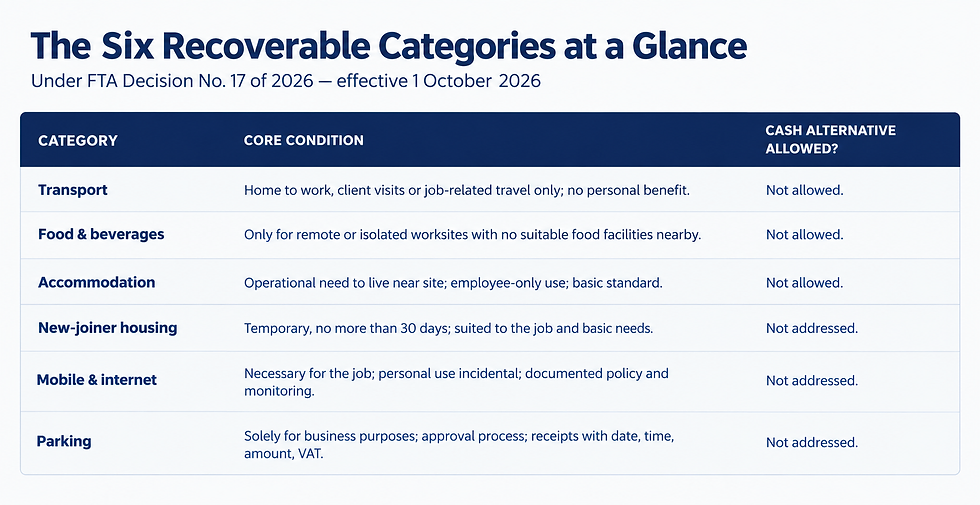
The Decision recognises six categories, and each carries its own conditions, so VAT on employee benefits in the UAE cannot be assessed as one block:
Transport: home to workplace, client premises or other job-related travel, with no personal benefit and no cash alternative for the employee.
Food and beverages: only for employees living in remote or isolated areas with no suitable food facilities nearby, and again with no cash alternative.
Accommodation: only where operational needs require the employee to live near the site, the employee uses it alone, and the standard stays basic.
New-employee accommodation: temporary housing for no more than 30 days that suits the job and basic residency needs.
Mobile, airtime, data and home internet: necessary for the job, with only incidental personal use, a documented policy and reasonable monitoring.
Parking: solely for business purposes, supported by an approval process and receipts showing date, time, amount and tax paid.
Training courses, uniforms and similar benefits do not appear among the six cases, so they need separate assessment before anyone claims VAT on them.
What Conditions Must You Meet Before Claiming?
To recover VAT on staff expenses, a business needs a contractual obligation or documented policy and must then satisfy every condition listed for the relevant case, because one failed condition defeats the whole claim.
One of the common issues we see is a salary structure that includes a transport or housing allowance, which can signal a cash alternative and weaken the claim. At Pearl Accounting, we typically recommend checking how allowances appear in contracts and in your payroll and WPS compliance records before treating a benefit as provided in kind.
We see the same pattern with Dubai retail and trading businesses that offer a flat monthly transport allowance to warehouse staff. Because the employee can effectively take the cash instead of the ride, the allowance reads as a cash alternative, and that alone is enough to put the whole transport claim at risk.
How Do You Separate Business Costs From Personal Ones?
A business cost exists because the job requires it, such as a commute to a client site, a phone used for out-of-hours calls or parking during a client visit. A personal cost mainly benefits the employee privately, such as a phone plan used chiefly for streaming or parking used at weekends, and FTA Decision No. 17 of 2026 returns to this distinction in nearly every case.
At Pearl Accounting, we typically recommend a short written usage policy, a named approver and a quarterly review, and our team can check your current wording during a free consultation.
If you are not sure your phone and parking policies would hold up under review, contact Pearl Accounting for a quick documentation check.
Check the Invoices and Expense Records
Before any claim reaches your VAT return, your finance team should confirm each of the following:
The tax invoice shows the supplier's name, address and TRN, the date, the amount and the VAT charged, plus your company details where the invoice type requires them.
The contract or documented policy that creates the entitlement is on file and matches the category you are claiming under.
Evidence supports each condition, such as phone usage logs, parking approvals and a note explaining why a remote site lacks nearby food options.
The payment, invoice and ledger entry agree, and the supplier passes the verification checks introduced under FTA Decision No. 13 of 2026.
Strong reconciliation in accounting records makes these checks far easier, because they match each benefit invoice to its payment and payroll entry, and our team often finds mismatches long before the Authority does.
A restaurant group with several branches shows why this matters in practice: parking and delivery-related claims across multiple sites are hard to defend without monthly reconciliation tying each invoice to a payroll or site record. Our bookkeeping team builds this matching into the normal monthly close, rather than leaving it for year-end.
How Would a Dubai SME Assess VAT Recovery in Practice?
Consider a Dubai consultancy that sends one employee to Abu Dhabi for three days of client work and pays for the hotel and meals. Business travel like this is a cost of the trip rather than a benefit provided under a contract or policy, so the Decision does not govern it, and the company tests the claim under the general input tax rules: a taxable business purpose, a valid tax invoice and no personal element such as a leisure extension.
The position changes when the same company houses a new joiner in a serviced apartment for three weeks. That arrangement is a free benefit under the offer letter, so the new-employee accommodation case applies, and the VAT stays recoverable only while the stay remains temporary, within 30 days and suited to basic needs. In our experience, SMEs handle the first situation well and stumble on the second because nobody tags the two costs differently in the books. We advise coding trip costs and staff benefits separately in your bookkeeping, which works smoothly in Zoho, Xero and QuickBooks through our accounting software services in the UAE.
Where the facts are unclear, such as a trip that doubles as a relocation visit, our VAT consultants in Dubai document the reasoning before the claim enters the return.
Facing a borderline case in your own business? Talk to our VAT team before the claim goes into your return, not after.
What Should the Finance and HR Teams Do Next?
Because the Decision already applies to periods from October, a short internal review now protects input VAT on employee expenses in the UAE before your next filing:
List every staff benefit on which you recover VAT, including housing, transport, meals, phones, internet and parking.
Match each benefit to one of the six cases and pause any claim that fits none of them.
Check that contracts and HR policies create the entitlement, and remove cash-in-lieu options where the conditions forbid them.
Draft the missing phone and parking policies, including approval and monitoring steps.
Show any irrecoverable VAT in the right cost lines of your management accounts and financial reporting.
Each unreviewed benefit line represents VAT that is either being left unclaimed or claimed incorrectly, and both carry a cost at filing time. Running this review alongside your Corporate Tax and E-Invoicing readiness checks keeps input tax recovery, Corporate Tax compliance and E-Invoicing preparation on a single timeline instead of three separate ones.
Turning the New Rules Into a Cleaner VAT Position
The Decision gives employers a clear route to claim back VAT on staff costs, yet it rewards businesses that prepare their paperwork before the Authority asks questions. Sound input tax recovery in the UAE depends on matching each benefit to a case, supporting it with a contract or policy and keeping evidence you can produce quickly.
Pearl Accounting & Financial Services LLC supports startups, SMEs and established enterprises across the UAE, and we work remotely so clients anywhere in the country can reach us easily. If you want to recover VAT on staff expenses with confidence, schedule a free consultation with us today or message us on WhatsApp.
Whether you run a single-site consultancy or a multi-branch trading business, the principle is the same: claim what the Decision allows, document it properly, and let your VAT position stand up to scrutiny on its own.
FAQs:
How does a transport allowance in the payslip affect my VAT claim? A fixed amount can mean that the employee is allowed to accept cash rather than the transport facility offered by you, and the Decision mandates that there should be no cash equivalent of transport, food, and accommodation. Ensure that your contractual provisions reflect your benefit provision correctly.
What if a newly hired employee continues staying in company housing for more than 30 days? The temporary accommodation case is terminated on the 30th day, so future VAT becomes a standard accommodation case, which is otherwise irrecoverable. Proper tracking of the hire date of each new employee enables timely identification of termination of the temporary accommodation case.
Can phone plans provided by the company as an employee benefit become eligible for input tax recovery despite their personal use?
Yes, as long as personal use remains occasional and insignificant, and there is written policy and appropriate control mechanisms.
Do training courses and uniforms fall under the Decision?
Neither appears among the six cases, so VAT on employee benefits in the UAE outside that list needs its own assessment before you claim. Record your conclusion for each cost so it is ready if the Authority asks.
Who should own these claims, finance or HR?
Both teams need to take part, because HR holds the contracts and policies while finance holds the invoices and the VAT return. At Pearl Accounting, we typically recommend a joint review each quarter.


Comments